One Bank, Three Balance Sheets: How to Know When Personal and Commercial Banking Support Is Right for You
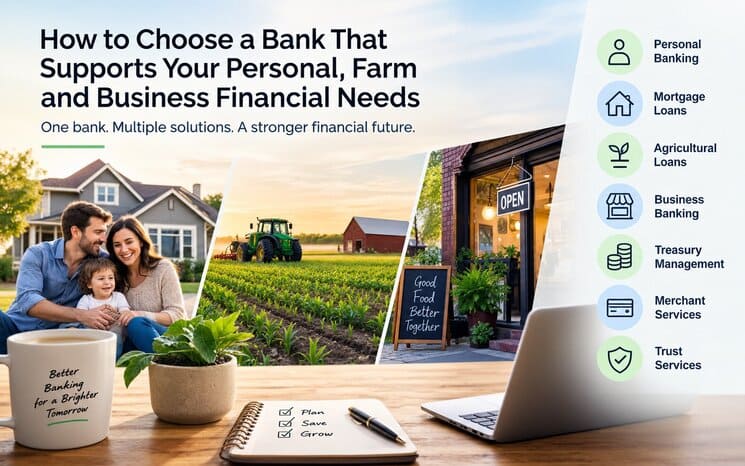
Most banking advice starts with a list of products. Real financial life doesn’t work that way. Money moves between a paycheck and a mortgage, a harvest and a loan payment, a customer’s purchase and a business account. Farmers Bank in Idaho is built around that movement. It offers checking and savings accounts, agricultural and mortgage loans, digital banking, commercial lending, treasury management, merchant services, and trust services. That means a family opening its first account, a rancher researching ag loans coeur d’alene, and a business owner planning an expansion can all be served by the same institution, with secure, reliable support behind each decision.
This guide walks through three illustrative scenarios (composites, not real customers) and then helps you decide whether it’s time to reach out to a bank like Farmers Bank for your own situation.
Scenario One: The Household That Needs Stability
Picture a couple with two incomes, a toddler, and a goal of buying a first home. Their needs are personal banking at its most practical.
- Checking absorbs direct deposits and pays the bills.
- Savings holds the emergency fund and, eventually, the down payment.
- Digital banking lets them move money, deposit checks from a phone, and set up alerts so an odd transaction doesn’t go unnoticed.
- A mortgage is the big step. Here, the quality of the conversation matters as much as the rate. A lender who explains the process in plain terms, and who is reachable when the paperwork stalls, makes a stressful milestone far more manageable.
Time to talk to a bank if: you’re within a year or two of buying a home, your savings have outgrown a basic account, or you want a lender who knows your local market.
Scenario Two: The Farm on a Seasonal Clock
Now consider a family farm. Income may arrive once or twice a year, but seed, fuel, feed, labor, and repairs are due every month. A loan with even monthly payments can feel designed for someone else’s calendar.
That is why agricultural lending exists as its own discipline. A farm loan can cover operating costs through the growing season, fund equipment, or help buy land, with repayment shaped around harvest and production cycles. Just as important is the lender’s understanding of weather risk, commodity price swings, and the capital intensity of farming.
The farm also shows how blurred the personal and commercial lines can get. The farmhouse mortgage, the operating line, the equipment loan, and the family’s savings all feed one financial picture. A bank that sees both sides can give better advice than one that sees a single account.
Time to talk to a bank if: your operating costs arrive well before your revenue, you’re planning to buy land or equipment, or you want to line up credit before the season starts rather than during it.
Scenario Three: The Business That Needs to Run Smoothly
Finally, consider a local restaurant opening a second location. Its challenges are cash flow timing, payroll, equipment, and getting paid quickly and safely.
- Commercial lending funds the build-out, equipment, or real estate. A loan that fits the business’s cash flow supports growth, while a mismatched one strains it.
- Merchant services let the business accept card and electronic payments, which directly affects sales and customer experience.
- Treasury management brings order to a growing operation through tools for managing cash, processing payments, and guarding against fraud.
Day-to-day spending is another place where small choices add up. New owners often ask what is a business check card, and the short answer is that it’s a debit-style card tied to a business checking account. It lets the owner or authorized employees pay for supplies and expenses directly from business funds, and it keeps company spending separate from personal spending. That separation makes bookkeeping cleaner, tax time easier, and your financial records more credible when you later apply for a loan.
Time to talk to a bank if: you’re mixing personal and business money, planning to expand, or spending more time chasing payments than serving customers.
Where the Three Stories Meet
Step back and the scenarios share more than they differ. The couple might one day buy farmland or start a business. The farmer’s household depends on the farm’s income. The restaurant owner’s savings may have funded the launch. Personal and commercial banking are two views of the same financial life.
When your banker understands both your household and your enterprise, advice becomes more relevant and decisions tend to move faster. That relationship becomes an asset in its own right.
Planning Ahead: Trust Services
Success eventually raises a new question: what happens to everything you’ve built? Trust services help families and owners plan for that stage by managing assets, supporting estate planning, and carrying out their wishes. For a farm or family business, this is often the core of succession planning, helping an operation pass to the next generation without disruption. When these services sit under the same roof as your accounts and loans, the planning rests on a fuller understanding of your finances.
How to Decide If Farmers Bank Is the Right Fit
Asking for financial help is easier when you know what to look for. Before you reach out, ask yourself:
- Do I need more than one service? If you need a mix of accounts, lending, payment tools, or long-term planning, a full-service bank saves you from managing several relationships.
- Does the lender understand my line of work? Agriculture, retail, and professional services all carry different cash flow patterns. Ask how the bank structures credit for businesses like yours.
- Can I reach a real person? A community bank’s advantage is often access to someone who knows your situation, not just a call center queue.
- Will the bank grow with me? The right partner can support you from a first checking account to a business loan to estate planning.
- Are digital tools secure and easy to use? You should be able to manage money anytime without compromising safety.
Before Your First Conversation
You don’t need a perfect plan to start, but a little preparation makes the meeting more productive.
- For personal loans or a mortgage: gather recent pay records, a list of your monthly obligations, and a rough idea of your budget and timeline.
- For farm or business financing: bring a summary of your operation, recent financial statements, an outline of what you want to fund and why, and your repayment expectations.
- Questions to ask: What loan structure fits my cash flow? What does the process and timeline look like? Which accounts or services should I set up alongside the loan?
Approval depends on your financial situation and the bank’s standards, so treat the first meeting as a way to learn your options, not a commitment.
The Bottom Line
The best question to bring to a bank isn’t “What products do you offer?” It’s “Can you support where I am now and where I’m heading?” For households, farmers, and business owners in Idaho, Farmers Bank offers that continuity: personal and commercial services, agricultural expertise, modern digital tools, and long-term planning in one relationship. If you’re facing a purchase, a season of heavy expenses, or a growth decision, a conversation with a local banker is a low-risk first step toward getting the right financial help.

Pranab Bhandari is an Editor of the Financial Blog “Financebuzz”. Apart from writing informative financial articles for his blog, he is a regular contributor to many national and international publications namely Tweak Your Biz, Growth Rocks ETC.