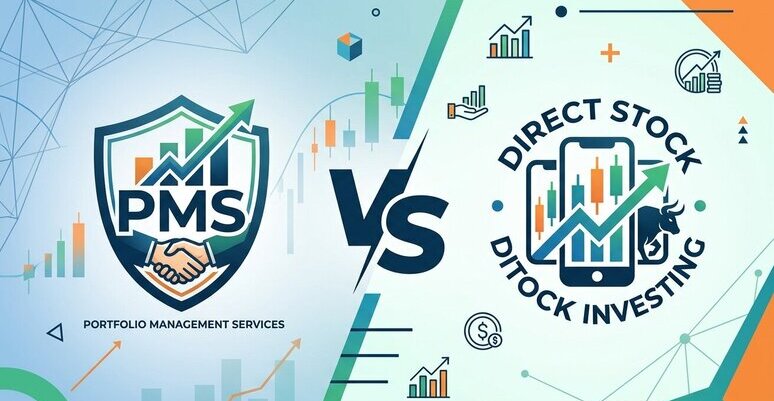
PMS vs. Direct Stock Investing: Is Your “DIY” Portfolio Costing You More Than Just Time?
In the current bull market of 2026, the allure of the “Do-It-Yourself” (DIY) portfolio has never been stronger. With sleek trading apps and a wealth of information at our fingertips, many high-net-worth individuals (HNIs) assume that if they aren’t paying a management fee, they are already winning the race. The logic seems sound: why give away a % of your wealth to a fund manager when you can pick the next multi-bagger yourself?
However, the actual question isn’t about the fees you see; it’s about the costs you don’t. As portfolios grow, the complexity of managing them scales exponentially. To clear the air, let’s define our two contenders:
- Direct Stock Investing: You personally research, select, and execute trades through a demat account, maintaining full control over every buy and sell decision.
- Portfolio Management Services (PMS): A SEBI-regulated professional service where a dedicated fund manager manages your portfolio, tailored to specific strategies, with a regulatory minimum investment of ₹50 Lakhs.
What Each Option Actually Means
Before diving into math, it is essential to understand the structural differences.
Direct Investing is the ultimate democratic tool. There is no entry barrier or minimum investment. You make all the calls, from macro-allocation to the specific timing of a mid-cap exit. It is highly flexible but places the entire burden of success and failure on your shoulders.
Notably, a portfolio management service, on the other hand, is a sophisticated investment vehicle. There are two primary types: Discretionary (where the manager makes all decisions) and Non-Discretionary (where the manager suggests, but you approve).
The Costs DIY Investors Usually Track
When a DIY investor calculates their “cost of investing,” they usually look at their contract notes. These costs are visible and easy to quantify:
- Brokerage Fees: Usually minimal in the age of discount brokers.
- Securities Transaction Tax (STT): A fixed percentage on every purchase and sale.
- Exchange Charges and GST: Fractional costs that barely dent a long-term portfolio.
If you aren’t overtrading, these “visible” costs often stay quite low. On paper, the DIY route looks like a financial masterstroke compared to a professional fee.
The Costs They Usually Don’t (The “Hidden” Leakage)
This is where the DIY argument often falls apart under scrutiny. Professional investing involves three massive “hidden” costs that most retail investors ignore.
1. The Tax Drag
Following the Budget 2024 changes, the Short-Term Capital Gains (STCG) tax stands at 20%. For a DIY investor, the temptation to “book profits” or rotate sectors frequently creates a massive tax leak. Every time you churn your portfolio, you lose 20% of your growth to taxes. A PMS, while also subject to capital gains, typically operates with a long-term institutional framework designed to minimize unnecessary churn and optimize post-tax returns.
2. The Cost of Time
Serious stock research isn’t a hobby; it’s a full-time job. To manage a diversified portfolio of 20–25 stocks effectively, you need at least 8 to 10 hours a week for deep-dive research, earnings call analysis, and macro monitoring. For a senior professional or business owner, time is their most expensive commodity. If your hourly value is ₹5,000, you are “spending” nearly ₹20 Lakhs worth of time per year on your portfolio. Is your alpha (outperformance) high enough to cover that?
3. The Behavioural Cost
Investor underperformance is often behavioural, not analytical. A 2023 Nielsen survey commissioned by Samco Securities found that 67% of investors failed to beat benchmark returns, underperforming by roughly 4–5% annually. SEBI’s 2024 intraday trading study reported that 71% of retail intraday traders lost money in FY23, rising to 80% among frequent traders. In derivatives, SEBI’s September 2024 study found that 93% of individual F&O traders lost money between FY22–FY24, with aggregate losses exceeding ₹1.8 lakh crore. Panic-selling, overtrading, and momentum chasing remain key drivers of this behavioural gap.
What PMS Fees Actually Buy
When you pay a PMS fee you aren’t just paying for someone to pick investments. You are paying for:
- Portfolio Construction: PMS portfolios are usually built across carefully allocated positions with defined exposure limits, diversification rules, and periodic rebalancing to reduce concentration risk.
- Risk Management: Unlike most DIY portfolios, PMS managers actively monitor drawdowns, liquidity, sector exposure, and cash allocation during volatile market phases.
- Research & Monitoring: Professional PMS teams use institutional research, management interactions, earnings tracking, macro analysis, and valuation frameworks that individual investors often cannot maintain consistently alongside a full-time career.
- Compliance & Transparency: SEBI regulations require PMS providers to maintain audited reporting, disclosures, and standardised performance reporting.
The numbers support this framing. Across 60 equity PMS strategies with a 10-year track record, the average CAGR through July 2024 was 17.35%, against BSE 500 TRI’s 15.67% and Nifty 50 TRI’s 13.80% over the same period. Even after accounting for a management fee, the gap holds for many strategies.
When DIY Makes Genuine Sense
- Your Portfolio Is Still Relatively Simple: If your investment size, diversification needs, and financial goals are still manageable without institutional-level oversight, direct investing can remain practical and cost-efficient.
- You Have Genuine Market Expertise: If you possess deep knowledge, research capability, and the ability to evaluate businesses consistently, managing your own portfolio may give you an edge.
- You Have a Proven Track Record: If you have consistently outperformed relevant market benchmarks over a 3+ year period on a post-tax basis, you may already have the discipline and process required to manage your own capital effectively.
One Honest Way to Check Where You Stand
If you actively manage your own portfolio, perform this simple “Truth Audit”:
- Calculate Your XIRR: Don’t rely on absolute returns alone. Use XIRR to measure your actual portfolio performance after accounting for the timing of investments and withdrawals.
- Compare Against a Relevant Benchmark: Did your portfolio genuinely outperform the broader market on a risk-adjusted basis, or were returns largely driven by a strong market cycle?
- Account for the Hidden Costs: Include taxes paid on realized gains, transaction costs, and the time spent researching, tracking, and managing your investments.
If your post-tax, all-in return consistently trails a relevant benchmark or professionally managed alternatives, your “low-cost” DIY portfolio may not be as efficient as it appears.
The Bottom Line
The question was never really “PMS or DIY?” It was always: is your capital working as efficiently as it should be?
For investors with genuine market expertise, a consistent post-tax track record, and the capacity to treat portfolio research as a serious discipline, direct investing can remain a legitimate and cost-effective approach.
For the rest, the real cost of DIY does not sit in the brokerage line on your contract note. It sits in the tax drag from unnecessary churn, the hours spent on research a full-time professional already does systematically, and the behavioural slippage that quietly compounds over years.
If an audit shows you are trailing net of tax, the management fee you have been avoiding may well be cheaper than the costs you have been ignoring.
Frequently Asked Question (FAQ’s)

Pranab Bhandari is an Editor of the Financial Blog “Financebuzz”. Apart from writing informative financial articles for his blog, he is a regular contributor to many national and international publications namely Tweak Your Biz, Growth Rocks ETC.