
The Hidden Factors Influencing Your Daily Trading Decisions
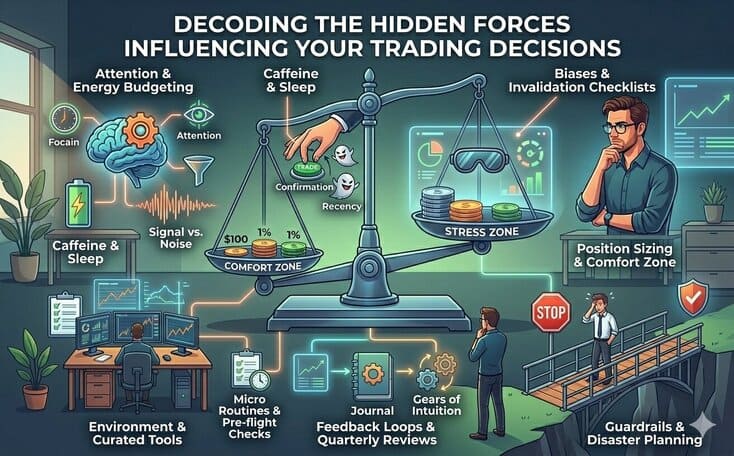
Most traders believe they make choices based on charts, news, and a clear plan. In reality, a series of hidden influences shape decisions long before the order ticket opens. Energy levels, cognitive biases, screen layout, and the cadence of your day can nudge you toward trades that feel right yet stray from your process. Understanding these forces does not remove uncertainty, but it gives you practical ways to reduce noise and keep your edge consistent.
The Unseen Drivers: Attention, Energy, and Noise
Your first constraint in each session is not the market; it is attention. Sleep quality, caffeine timing, and competing priorities change how well you filter signals from noise. On days when energy is low, you will be more likely to chase moves late or skip validation steps that require effort. The remedy is a light scaffolding around the focus. Set a short pre‑market routine that includes one page of levels, scenarios, and a maximum number of instruments you will track. Limit screens to what informs your entries, exits, and risk. Use alerts so your eyes are not glued to every tick. When attention is budgeted on purpose, you conserve it for the moments that matter most.
Biases That Sneak into Execution
Even experienced traders are not immune to loss aversion, recency bias, or confirmation bias. After a loss, it is common to downsize winners quickly and let losers linger because closing a losing trade makes the pain feel permanent. After a streak of wins, traders often overestimate skill and widen risk without noticing. Recency bias pushes you to overweight the last few outcomes rather than the long-run expectancy of your setup.
Make bias management part of your checklist. For each setup, define invalidation in advance and write the exit condition in plain language. Preload orders with bracketed stops and first scale targets so you are not negotiating with yourself when the price gets close. Keep a small note on your screen that asks two questions before entry: what would convince me I am wrong, and where is the next best trade if this one does not trigger. Many call this mental work the Psychology of Trading, but it becomes practical only when it lives inside rules and prompts that you see and follow during the session.
Position Sizing and the Comfort Zone
Sizing is where mindset meets math. A method with a positive expectancy can still fail if position sizes are set above your emotional tolerance. Oversized positions change behavior. You will cut profits early, move stops, and avoid the next valid trade because the last one felt too intense. Choose a fixed fraction of capital per trade or a fixed cash risk per setup, then keep it constant for a full review cycle. Create a simple staircase for scale changes, for example, raise size one step only after ten rule-compliant trades regardless of outcome, and reduce size after three consecutive rule breaks. This keeps your comfort zone aligned with your plan rather than with the last big candle.
Environment, Tools, and Micro Routines
Many decision errors are environmental. Cluttered charts, overlapping indicators, and a chaotic workspace slow perception and create friction. Curate your tools. Keep a core group of instruments you know well, build two or three standard chart layouts, and archive indicator experiments that did not improve results. Use a naming convention for watchlists and saved layouts so you are never hunting for context when the market is moving.
Micro routines reduce slippage between plan and action. At the open, spend the first five minutes observing rather than trading unless a pre‑defined A‑setup is present. Before placing any order, run a ten-second pre‑flight check, entry trigger, stop location at invalidation, position size that fits risk, and first scale target. After the trade, run a ten-second post‑trade check to log the rationale and mark any deviation. These tiny habits create glide paths that are hard to abandon when emotions rise.
Feedback That Builds Better Intuition
Intuition improves when it is fed accurate feedback. A daily journal does not need to be a novel. Capture a screenshot at entry and exit, tag the setup, market regime, and any deviation from rules, and record whether your stop or target was market-based or emotion-based. Once a week, review your trades by setup rather than by day. Look for patterns that repeat. Maybe your breakout entries work on strong breadth days but fail in low liquidity afternoons. Maybe mean reversion trades perform best only when volatility closes below a threshold. Use one change per week to avoid introducing noise, and measure whether that change improved the average outcome or reduced variance.
Add a quarterly review that tests your playbook against a few simple regime filters. For instance, segment your results by trend strength, intraday range compression, or gap frequency. You may discover that one setup pays most of your edge while another is neutral or negative. Cutting a neutral setup frees attention and risk budget for what truly compounds.
Guardrails for Days That Do Not Go to Plan
No matter how well prepared you are, some sessions will unravel. Build guardrails in advance. Set a daily stop for realized losses and a separate stop for rule breaks. If either is hit, step downsize or stop for the day. Keep a short reset routine for mid-session stress: stand up, breathe for one minute with eyes off the screens, and write a single sentence about what the market is doing, not what you want it to do. If personal life demands are high, pre‑decide to trade only the first hour or only pre‑planned levels, then step aside. Good traders protect their ability to trade tomorrow more than they chase perfection today.
Conclusion
Hidden forces shape every trading day, from attention and energy to biases, sizing, and the design of your environment. By making these factors visible and building simple routines around them, you shift decisions from impulse to intent. The work is not dramatic. It is a series of small, repeatable actions that keep you close to your edge and away from preventable errors. Over time, that quiet discipline separates consistent performance from costly noise.

Pranab Bhandari is an Editor of the Financial Blog “Financebuzz”. Apart from writing informative financial articles for his blog, he is a regular contributor to many national and international publications namely Tweak Your Biz, Growth Rocks ETC.