Understanding the Relationship Between Gold Price Today and Stock Market Movements
For centuries, gold has been a symbol of wealth and a store of value. Even in modern investment portfolios, it features as a safe-haven asset that investors turn to for protection during times of market volatility or economic uncertainty. Due to the resilient nature of the precious metal, the gold price today is one of the most closely tracked metrics in the world.
Now, while a gold investment offers stability, the stock market offers the potential for exponential growth. Understanding the differences in characteristics between these two investment options is essential to building a resilient portfolio that can handle market volatility.
How the Stock Market Influences Gold Prices
The stock market correlation with gold is one of the most important relationships in finance. Let us explore how equities influence the prices of the precious metal.
1. The Inverse Relationship: When Equities Fall, Gold Tends to Rise
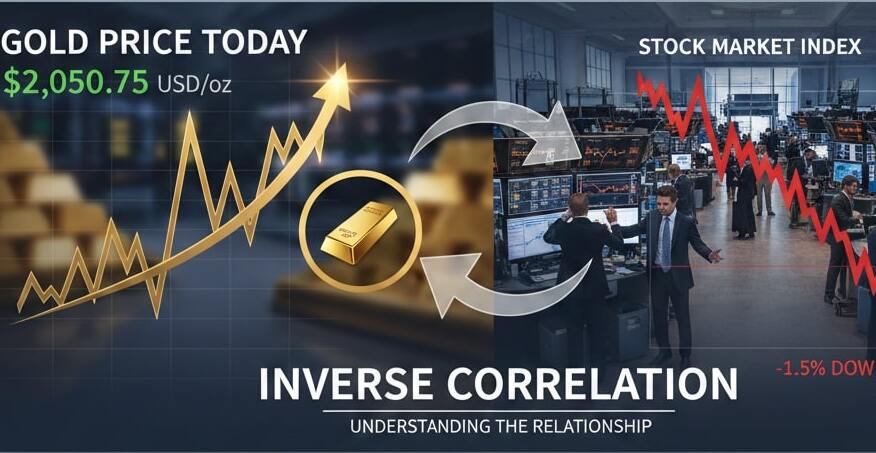
Gold and the stock market typically share an inverse relationship. This means the two asset classes often move in opposite directions, driven by a complex set of economic factors.
For example, when the economy is strong and growing, corporate profits rise, making stocks more attractive. This leads investors to move their capital from other assets like gold into stocks. The increase in demand drives equity prices up and gold prices down.
Now, imagine a major geopolitical crisis erupts overnight, leading to massive economic uncertainty. Investors panic and sell their stocks, causing the market to crash. During such times, they invest the capital into safe-haven assets like gold. The sudden surge in demand causes the gold price today to rise sharply, even as the stock market falls.
2. Economic and Geopolitical Factors Influencing Both Markets
There are several economic, domestic and geopolitical factors that influence both asset classes in different ways. Here are a few of the key aspects explained in detail.
- Inflation
High inflation erodes the purchasing power of cash. Both gold and the stock market respond differently to rising inflation. For example, gold is considered a direct hedge. As the value of currency falls, the gold rate in India tends to rise. For stocks, the effect is more complex. Mild inflation can be good, but high inflation raises costs for companies and can hurt profits. It also leads to higher interest rates, which often lead to a drop in stock prices.
- Interest Rates
Interest rates are among the most powerful drivers of gold market trends and the stock market. When central banks raise interest rates, it makes new government bonds highly attractive. Investors respond to it by selling gold and investing it in bonds, which causes gold prices to fall.
High rates also hurt the equity market by making it more expensive for companies and consumers to borrow money. High borrowing costs lead to lower revenue and profits, both of which negatively impact share prices.
- Central Bank Policies
Beyond just setting rates, central bank actions take quantitative easing measures like printing more money or devaluing the currency. Such measures tend to push up the price of real assets, including gold and stocks. On the other hand, quantitative tightening measures, where the existing money supply in the economy is reduced, have the opposite effect. Additionally, central banks themselves are also huge buyers of gold. Their purchasing demand adds a strong layer of support to the gold rate in India.
- Economic Growth (GDP)
Strong economic growth means companies are thriving and unemployment is low. This is a good environment for the stock market, as corporate earnings and profits often go up. While this might be good for stock prices, it is not always a good sign for gold market trends. The demand for gold in such an environment drops, which can cause its price to drift lower.
- Currency Fluctuations (USD-INR Exchange Rate)
The gold price today is denominated in US dollars (USD) on the global market. India imports most of its gold from the international markets. So, when the USD gets stronger relative to the Indian rupee (INR), the price of gold skyrockets as more money is now required to purchase the same quantity of gold. On the other hand, a stronger INR makes gold cheaper for Indian buyers.
- Geopolitical Instability
Gold is a safe-haven asset. Any event that creates global uncertainty, like a war, a trade dispute or a political crisis, often leads to investors selling assets they perceive as risky, such as stocks. They then use the capital to buy assets they perceive as safe, like gold. This is why major conflicts often trigger a sharp spike in the live gold rate.
Why Investors Track the Gold Price Daily
Investors interested in the precious metals market consistently track the gold price today as it provides a real-time signal about the health and sentiment of the entire financial system.
1. Importance of Monitoring Gold Price Today for Short-Term and Long-Term Decisions
For short-term traders, the current gold market trends are very important. Since they generate profits from daily price fluctuations, constant monitoring of the trends and pricing is important to identify potential opportunities.
For long-term investors, the live gold rate is not as important. On the other hand, they are more focused on strategic capital allocation and the accumulation of gold. That said, they might still track the price periodically to make informed decisions.
2. How Price Trend Signals Market Uncertainty or Optimism
The gold price today is a powerful tool to gauge market sentiment. For instance, if the stock market is falling and the gold price is rising, it is a clear sign of market uncertainty and fear. Such a situation usually indicates that the investors are actively seeking safety and stability.
However, if the stock market is rising and the gold rate in India is falling, it can signal a different kind of sentiment. It may suggest that investors are optimistic about the wealth-creation potential of stocks and are therefore moving their capital from gold to the equity markets.
3. Use Cases for Portfolio Diversification
One of the primary reasons investors track the gold price today is to manage their portfolio’s diversification. The main goal of diversification is to own assets that do not all move in the same direction at the same time.
Since gold often has a negative stock market correlation, it is the perfect diversification tool. When your stock portfolio is going through a bad phase, your gold investment would likely be going through a good phase. This effectively balances out your returns and keeps the risk in check.
Historical Correlation Between Gold and Stock Markets
As an investor, closely examining past crises can often provide a clear picture of the gold-stock market correlation dynamic in action.
1. Instances When Gold Outperformed During Market Corrections
The COVID-19 pandemic in 2020 is a good example of gold market trends outperforming during corrections. As countries throughout the world, including India, imposed lockdowns to curb the spread of the virus, the stock markets reacted sharply by crashing.
During this same period, investors flocked to safety. Gold began its massive bull market, rising from around Rs. 42,430 per 10 grams on March 20, 2020, to over Rs. 57,490 per 10 grams on August 8, 2020.
2. Analysis of Recent Global Economic Events
The period from 2022 to 2024 has shown a more complex relationship. To fight inflation, central banks raised interest rates. During the period starting from April 08, 2022 to February 08, 2023, the Reserve Bank of India (RBI) increased the repo rate in stages, going from 4% to 6.5%.
The increase in rates created a major headwind for gold, as bonds became more attractive. However, at the same time, high inflation and significant geopolitical risks provided strong support for gold. As a result, the gold market trends were caught between high interest rates and a high-risk environment.
More recently, the period starting from January 31, 2025, to June 06, 2025, was positive for the gold market. The RBI reduced the repo rate from 6.5% to 5.5%, which made bonds less attractive. As expected, investors switched to gold, leading to a major rally that ended in the gold price in India reaching record levels in 2025.
How to Stay Updated on Gold Prices
In a market that moves every second, you cannot rely on yesterday’s news to make a gold investment decision. This is why reliable, real-time data is so crucial. The live gold rate allows you to see the price as it is right now and ensures you make decisions based on the most current information.
Whether you are a long-term investor or a short-term trader, you need a platform that is fast, accurate and transparent. A trustworthy platform like Samco Securities will show you the live gold rate today.
Conclusion
The gold-stock market correlation is fundamental to modern investing. Understanding the relationship between these two assets helps you make more balanced and strategic decisions. That said, it is important to note that the prices of gold and stocks can change quite rapidly. Therefore, it is advisable to make a habit of monitoring the gold price today to stay informed about the changing market dynamics.

Pranab Bhandari is an Editor of the Financial Blog “Financebuzz”. Apart from writing informative financial articles for his blog, he is a regular contributor to many national and international publications namely Tweak Your Biz, Growth Rocks ETC.